When a QR Code Menu Is the Wrong Call
Ask the internet about QR menus and you get several hundred comments of undisguised irritation. It is easy to dismiss that as people disliking change. It is also wrong: most of the complaints describe something real, and a restaurant that reads them properly can keep what the code is good at and stop paying for what it is not.
We sell this. That is exactly why the honest version is worth writing.
What the complaints are actually about
- A table stops being a table. Everyone looks down at a phone instead of at each other, and the thing people came out for is interrupted before the first drink.
- You cannot browse a phone the way you browse paper. A menu spread out is taken in at a glance and compared; a menu in a 6-inch window is scrolled, one dish at a time. People order what they can see, which is fewer things and usually cheaper ones.
- It excludes people. An older guest, a customer with poor eyesight, a dead battery, a cheap phone, no signal in a basement dining room. Every one of those is a person who now has to ask for help to read the menu.
- It feels like being measured. Right or wrong, diners assume a code exists to track them. Being asked to open your phone to eat reads as a transaction, not hospitality.
- It is usually done badly. A scanned PDF that needs pinching, a page that reloads between courses, an app install, a code taped to a sticky table.
Notice that only the last one is a technical problem. The rest are about what a menu is — a shared object on a table.
Where a QR menu is the wrong call
- Anywhere the meal is the occasion. Fine dining, tasting menus, anniversaries. If people dressed up, do not hand them a login screen.
- An older clientele. Not a guess — look at your own room on a Tuesday.
- Dim rooms and bad signal. Candlelight is flattering to faces and hostile to cameras. Basements and thick-walled buildings have no reception, and your Wi-Fi password is one more obstacle before dinner.
- A menu that never changes. The main argument for the code is that the content moves. If yours has been the same for three years, you are paying a convenience tax for nothing.
- As the only route. This is the one that turns irritation into a bad review.
Where it genuinely earns its place
- Anything that changes faster than you reprint. Specials, market price, the sixth thing that sold out tonight. Paper lies by dinner service; a code does not.
- Allergens and ingredients. Too long for the card, too important to be approximate, and safer as one page you can correct in a minute than as a laminate from last spring.
- Languages. Printed menus carry one, maybe two. A page can carry six, and the guest picks — which is worth more in a tourist town than any redesign.
- Takeaway, delivery, the counter queue. Nobody is sitting down; there is no table experience to protect.
- Hotel rooms, room service, poolside. Paper wanders off; the code on the desk does not.
- The full wine list. Forty by the bottle does not belong on a card, and the person who wants it will happily scan.
The answer most places land on
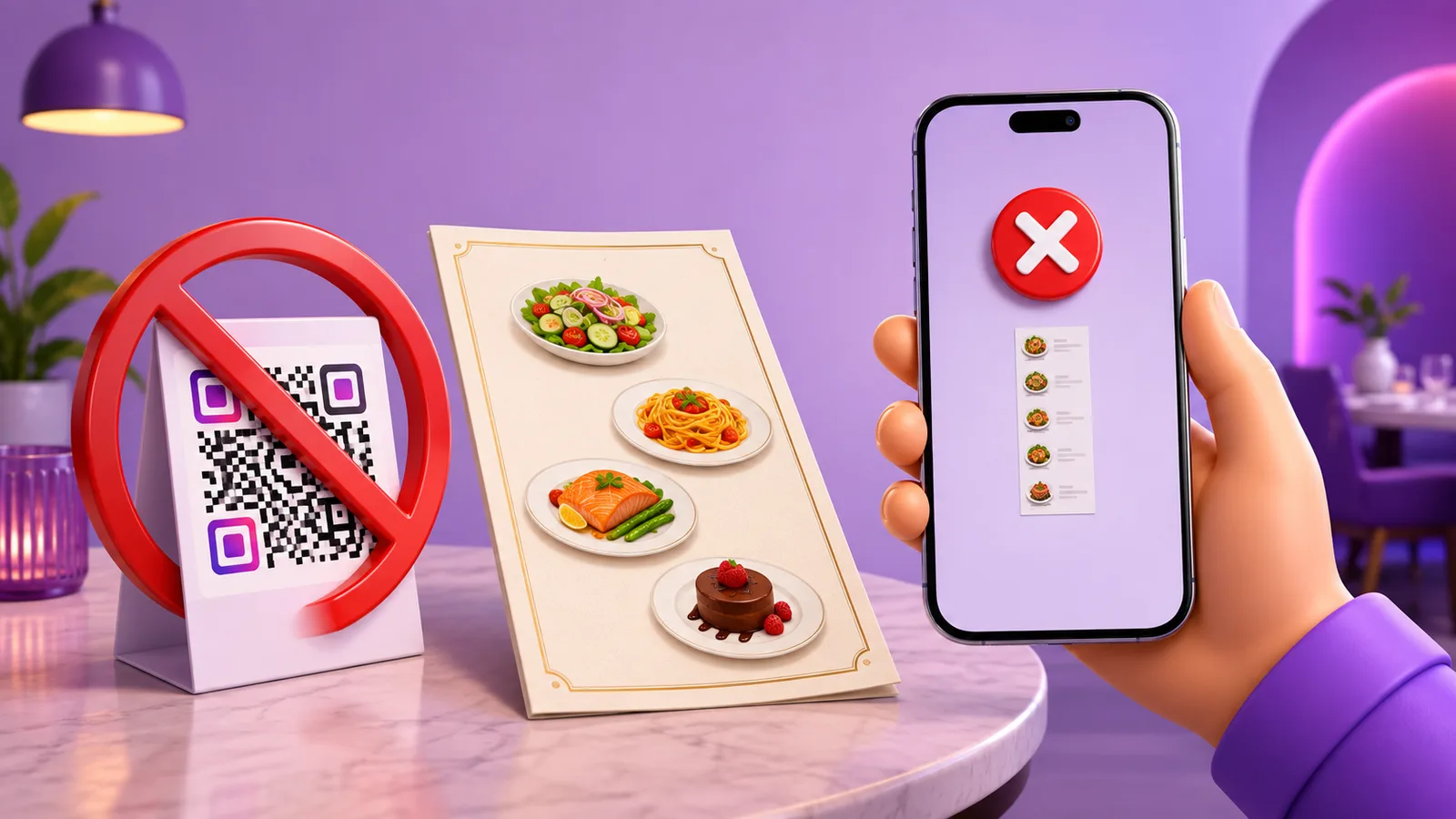
Paper on the table. The code beside it, for what paper cannot hold.
The card carries the menu people order from, and stays a shared object. The code carries the things that would ruin it: allergens in full, the wine list, tonight's specials, other languages, the nutritional detail nobody wants printed but some people need.
This is also the version where a dynamic code pays for itself, because those are exactly the things that change. You reprint the card when the menu changes, which was always true, and you update the rest without reprinting anything.
If you are keeping a QR menu, do these
- Keep some paper. Even a handful of cards for whoever wants one, handed over without a discussion.
- Print the address under the code. Short enough to type. It covers the flat battery, the borrowed phone and the guest who simply would rather not.
- Never a PDF. A PDF is a picture of a menu. It needs zooming, it downloads slowly on a bad connection, and it is unreadable to anyone using a screen reader. A plain web page is faster, lighter and legible.
- No app, no sign-in, no cookie wall before someone can read what the soup is.
- One code per table, printed large and matte. Gloss under low restaurant lighting reflects straight into the camera, and a code on a table gets covered in fingerprints — the single most common reason a menu code stops working.
- Test it at the worst table. The dim corner, on an old phone, with the lights as they are at nine in the evening.
- Watch what it costs you. If takings per head fell when the cards went away, the menu is doing less selling than it used to. That is measurable, and it is the number that should decide this rather than anyone's opinion.
Quick answers
- Are QR menus bad? As the only menu, usually yes. As a supplement to paper, they solve real problems.
- Why do people hate them? They break a shared table, they are hard to browse, and they exclude anyone without a good phone.
- What should the code carry? The things paper cannot: allergens, the full wine list, specials, other languages.
- Is a PDF menu fine? No. Use a web page.
- What if my menu never changes? Then you gain very little and give up quite a lot.
- Best setup? Paper on the table, a code beside it, and the printed address under the code.
The Enqre Team·Published on 6/30/2026·Updated 8/16/2026