Published on 8/3/2026
How to Choose a QR Code Generator: A Checklist for Before You Print
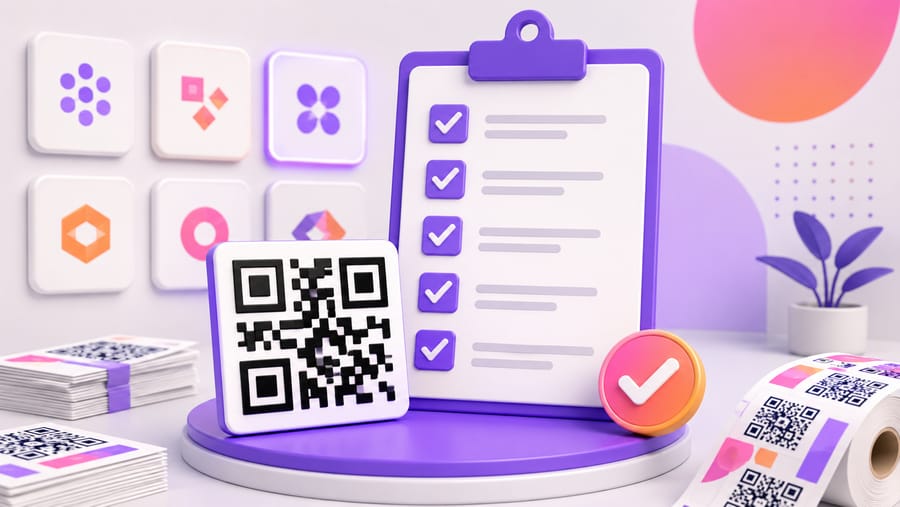
The decision looks like a feature comparison and is not one. Almost every provider offers colours, logos, analytics and a dashboard. What separates them is what happens to the code you already printed when the commercial relationship changes.
Here is the list, roughly in order of how much money a wrong answer costs. Our own answers are included — a checklist you cannot turn on the author is marketing, not a checklist.
1. After the free period, does my printed code still work?
The single most expensive question. A trial code that stops redirecting on day 15 turns a print run into waste. Ask it in exactly those words and accept nothing vaguer than yes or no.
Here: free codes do not expire. Five of them, 1,000 scans a month.
2. What happens if I stop paying?
Different question, same shape. When a subscription lapses, do the codes keep redirecting, revert to a limited free tier, or die? Providers rarely put this on the pricing page. Find it in the terms or ask support in writing.
Here: an account that lapses drops to the free plan's limits, and the codes keep working within them.
3. Is it actually dynamic, and is editing free?
Two traps in one. Many "free QR generators" produce only static codes, where the destination is baked into the pattern permanently. And some services let you create a dynamic code free and charge to change where it points — which is the only reason to have one.
Here: dynamic by default, and editing the destination is on every plan including free.
4. What happens at the scan limit?
There is a large difference between "we stop counting scans" and "we stop redirecting visitors". The second one takes your poster offline mid-campaign.
Here, and this is the unflattering one: past 1,000 scans in a month a free code shows a paused notice instead of redirecting, until the month resets. Paid plans have no scan limit. Know that before putting a free code on something with real traffic.
5. Whose domain does the scan pass through?
Every dynamic code redirects through somebody's short domain, and it is visible to your customers if you print the address under the code — which you should. An unfamiliar shortener domain on your own packaging is a small trust cost, and it is the same mechanism phishing uses.
Here: our domain by default; a custom domain and white-label are on the Business plan.
6. Is there an ad page or branding on the way through?
Some free tiers insert an interstitial before the destination. Scan a competitor's free code with your own phone before you decide — it is the fastest test on this list and it takes ten seconds.
Here: no ad interstitial. There is an interstitial only if you enable retargeting pixels, and that one exists to ask for consent.
7. What does the export actually give me?
For anything that will be printed large, you want vector — SVG or PDF — because a PNG blown up to poster size shows soft or jagged module edges. Check that vector export is not paywalled, and check the PDF is sized in millimetres rather than pixels if a printer will handle it.
Here: PNG and SVG on every plan including free, plus a print-ready PDF at 300 DPI with real millimetre dimensions.
8. What analytics are there, and what is honestly not there?
Ask what is collected and ask what is not. A provider that answers "everything you need" is telling you nothing. Also ask whether the data is exportable — analytics you cannot get out of the dashboard are analytics you will lose when you leave.
Here: scans over time, device, operating system, browser, referrer, unique visitors from a hashed IP. No location data at any price — we do not collect it, which also means we cannot report it. CSV export is on the paid plans.
9. Can I get my data and my codes out?
The lock-in question. Dynamic codes are inherently sticky: the printed pattern points at the provider's domain forever. What you can reasonably ask for is your scan history as a file, and — if you are printing at scale — a custom domain, because a code on your domain can be repointed at a different provider later without reprinting anything.
Here: CSV export of scans on paid plans, and custom-domain codes on Business, which is the only real exit route in this product category.
10. Where is the data, and who is the processor?
If you are in the EU or handling anything regulated, this comes up at the procurement stage rather than the marketing stage. Ask where scan data is stored and whether a data processing agreement is available.
Here: ask us — and for what a scan record contains, we published the field list rather than a paragraph of reassurance.
Two tests worth ten feature tables
- Scan the provider's own free code. Not a screenshot in their marketing — make one, print it on ordinary office paper, and scan it from a metre away with a phone that is not new. You will learn about interstitials, redirect speed and module size in under a minute.
- Print one before you print a thousand. Whatever you choose, order a single proof of the actual artwork on the actual material and scan it under the actual lighting. Every failure this article can describe is cheaper to find on one sheet.
Quick answers
- What is the most important question? Whether a code you printed keeps redirecting after the free period ends or the subscription lapses.
- Is a free plan enough? For a few codes and modest traffic, usually yes. Check the scan cap behaviour before relying on it.
- Do I need a custom domain? If you print at scale, it is the only thing that lets you change provider later without reprinting.
- Which export format matters? Vector — SVG or a millimetre-sized PDF — for anything printed larger than a business card.
- How do I compare analytics honestly? Ask what is not collected. Location is the usual example: many services infer a country from the IP, and we deliberately do not.
- What is the cheapest way to avoid all of this? Print one proof and scan it before the run.