A dynamic QR code looks like any other QR code, but with one crucial difference: you can change where it points at any time — even after it has been printed on a poster, a menu, or product packaging. It also lets you measure every scan. This guide explains what dynamic QR codes are, how they differ from static ones, how they work, and how to create one.
What is a dynamic QR code?
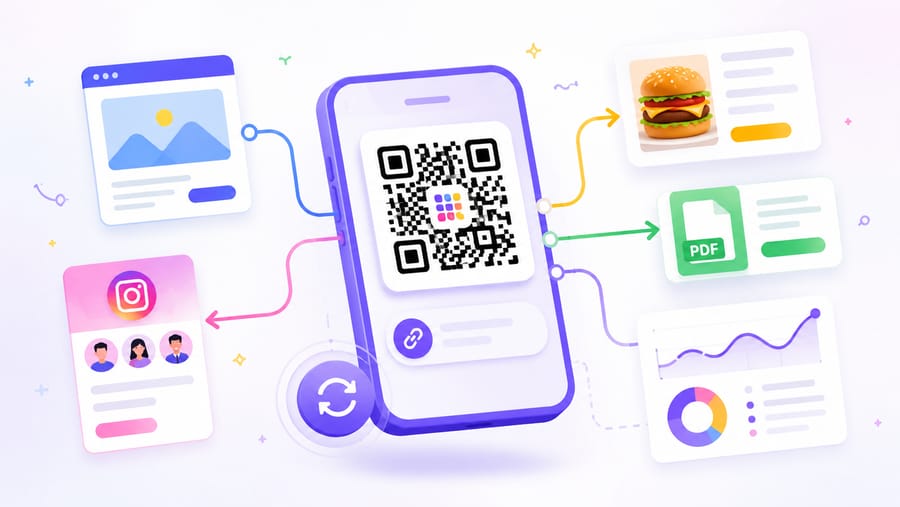
A dynamic QR code encodes a short redirect link rather than the final destination. When someone scans it, the link forwards them to whatever destination you have set at that moment. Because the destination is stored online instead of baked into the pattern, you can edit it whenever you like, and each scan can be recorded for analytics.
Dynamic vs. static QR codes
A static QR code encodes its destination directly. That makes it free and permanent — but also unchangeable: if the URL is wrong or the campaign ends, the printed code is dead. A dynamic QR code trades that rigidity for flexibility.
- Editable: change the destination after printing, no reprint needed.
- Measurable: see how many times, when, and on what devices your code is scanned.
- Smarter: route different visitors to different destinations, or A/B test them.
- Shorter pattern: because it only encodes a short link, the code is simpler and easier to scan.
Static codes are fine for a Wi-Fi password on the fridge. For anything you print at scale or want to track, dynamic is the better choice.
How dynamic QR codes work
When you create a dynamic code, the platform generates a short redirect URL (for example, enqre.com/r/abc123) and encodes that into the QR pattern. On scan, the visitor's phone opens the short URL, the platform looks up the current destination, records the scan, and forwards the visitor — usually in a fraction of a second. Editing the code later simply means updating that stored destination.
What you can do with a dynamic QR code
- Change the destination anytime without reprinting.
- Track scans by time, device, operating system, browser, and unique visitors.
- Set redirect rules so scanners are sent to different links based on their device, browser language, or the time of day.
- Run A/B tests by splitting scans between two destinations by weight.
- Brand the code with custom colors, a logo, frames, and a call to action.
- Restrict access with a password, an expiry date, or a maximum number of scans.
Popular use cases
- Restaurant menus: update dishes and prices without printing new table tents.
- Product packaging: point to a manual, a promo, or a re-order page — and change it per campaign.
- Print and outdoor ads: measure which poster or location actually drives scans.
- Events: a single badge or flyer code that evolves from "register" to "agenda" to "feedback".
- App downloads: send iOS users to the App Store and Android users to Google Play from one code.
How to create a dynamic QR code
- Pick the type of content — a link, a vCard, a menu, an App Store redirect, and so on.
- Enter the destination and design the code (colors, logo, frame).
- Download it as PNG, SVG, or a print-ready PDF, and publish it.
- Later, edit the destination or read your scan analytics from the dashboard.
With Enqre you can do all of this on a free plan whose codes never expire, and the advanced features — redirect rules, A/B testing, an API, webhooks, white-label and a custom domain — start at €9/month instead of the €99+ that enterprise tools typically charge.
Frequently asked questions
Can I change a dynamic QR code after printing it?
Yes. That is the main advantage: the printed pattern stays the same while you edit the destination it points to as often as you need.
Do dynamic QR codes expire?
They don't have to. It depends on the provider — with Enqre, codes on the free plan do not expire.
Are dynamic QR codes free?
Creating them can be free. Enqre's free plan includes dynamic codes with basic analytics; paid plans add higher limits and advanced features.
What can I track?
The time of each scan, the device, operating system and browser, and how many unique visitors scanned the code — shown in real-time dashboards.
Is a dynamic QR code slower to scan?
No. It encodes a short link, so the pattern is actually simpler; the redirect happens in a fraction of a second.
Ready to try it? Create your first dynamic QR code with Enqre — no credit card required.
The Enqre Team·Published on 6/21/2026·Updated 8/16/2026