Dynamic vs Static QR Codes: What's the Difference?
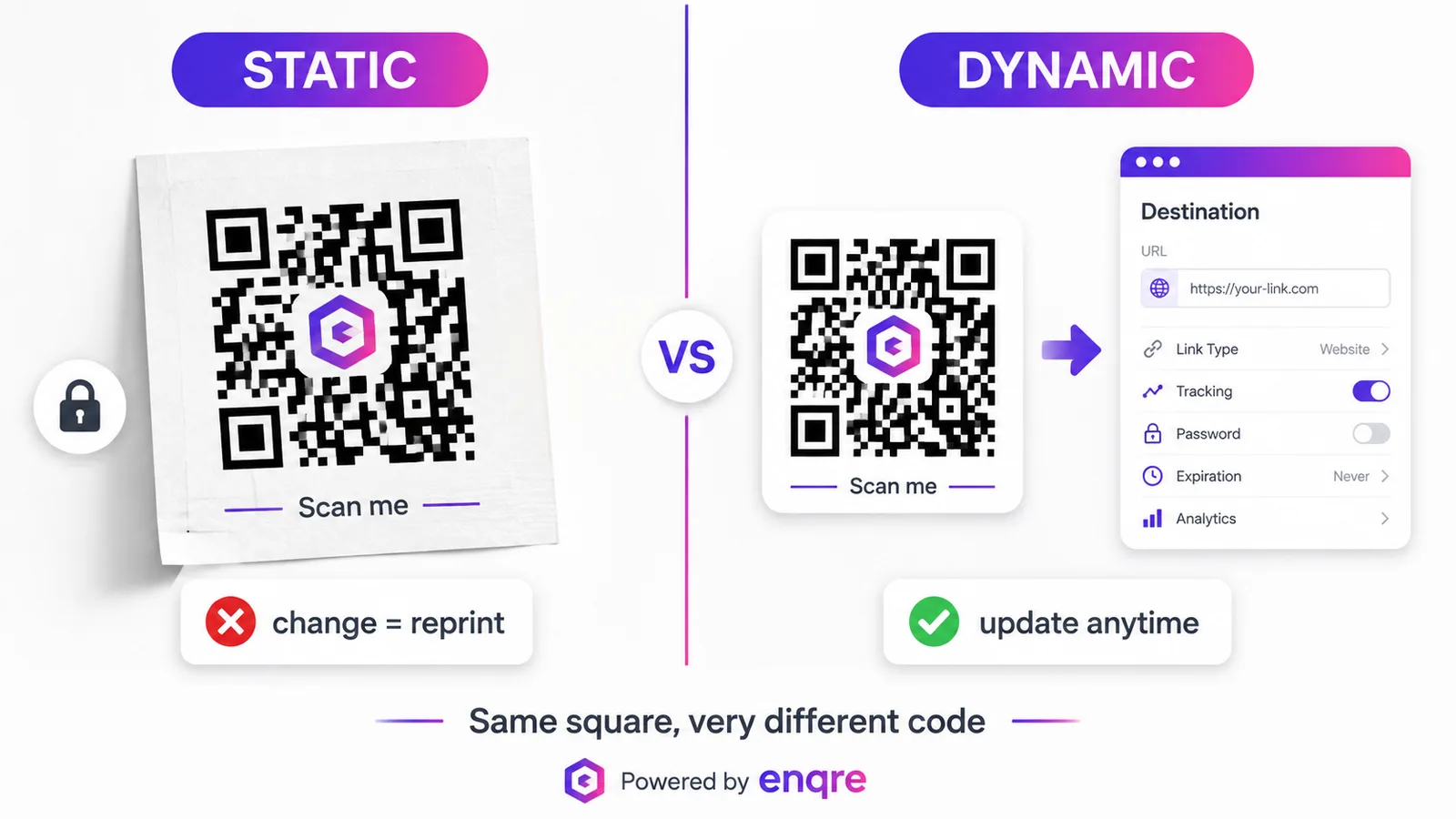
A static QR code has the destination written into the pattern. A dynamic one has a short redirect written into the pattern, and the destination lives on a server where you can change it. Everything else people say about the two follows from that one sentence — including the parts that are usually left out.
What is actually in the squares
Hold the two up and you cannot tell them apart. Both are ordinary QR codes and every scanner reads them identically; there is no such thing as a phone that supports one and not the other.
The difference is what the pattern spells out. A static code spells out the whole thing — https://example.com/autumn-sale-2026, or a Wi-Fi password, or a phone number. Nothing stands between the paper and the data. A dynamic code spells out something short and meaningless like enqre.com/r/ab12cd, and that address forwards to wherever you have pointed it this week.
The consequence nobody mentions: dynamic codes print better
Because a dynamic code carries about twenty characters instead of sixty or a hundred and twenty, it needs fewer modules. Fewer modules means each black square is physically larger at the same printed size — which means the code tolerates being printed smaller, on rougher stock, with more ink spread, under worse light.
This is genuinely useful and almost never said out loud. If you are squeezing a code onto a bottle neck, a business card or a shelf label, a dynamic code is not only more flexible than a static one, it is more likely to scan. A long campaign URL with UTM parameters baked into a static code is one of the more reliable ways to produce a dense, fragile pattern.
What static actually protects, and what it does not
"Static works forever" is half a sentence. The pattern works forever: it has no expiry, no account, no bill and nobody to ask. But the pattern only ever promised to hand the phone a URL, and a URL can 404. Your CMS gets migrated, the marketing site is rebuilt, the page moves, and the code still works perfectly while delivering people to nothing.
So static removes one dependency and keeps the other. Dynamic adds a dependency — the redirect service — but that added dependency is the one thing you can steer when the rest of the web moves underneath you. Whether that trade is good depends entirely on whether you would rather be unable to fix a problem or unable to avoid one.
The exception, and it is a real one: a static code holding Wi-Fi credentials, a contact card or plain text depends on nothing at all, not even the internet. A guest-room Wi-Fi card works during an outage. No dynamic code can say that, because a dynamic code is always a URL.
How to choose, in one question
Ask how the print run and the destination compare in lifespan.
- If the printed thing will outlive the thing it points at, use dynamic. This covers nearly all packaging, signage, menus, business cards and product labels — the box is printed in runs of fifty thousand and the offer changes in March.
- If the destination will outlive the print, static is fine and cheaper. A phone number on a van. A Wi-Fi password on a card. A link to a homepage that has survived two rebrands already.
- If you need to know whether anyone scanned it, dynamic, because there is no other option. A static code sends the phone straight to your server and nothing in between counts the trip — see how to track QR code scans.
When it is genuinely close, look at what a wrong guess costs. Being wrong about a static code means reprinting everything. Being wrong about a dynamic code means you paid for a redirect you did not need.
You cannot convert one into the other
This is the question that arrives too late, usually by email, usually after the print run. No, a static code cannot be made dynamic. The destination is in the ink. Changing it means changing the pattern, and changing the pattern means new artwork and a new print run — there is no software step that rescues a square already sitting on forty thousand cartons. Editing a QR code goes into what is and is not possible after printing.
Which is the actual argument for defaulting to dynamic on anything printed at scale. Not that you know the destination will change, but that you do not know it will not.
Frequently asked questions
Do dynamic and static codes scan differently?
No. Both are standard QR codes and any scanner reads either. If anything the dynamic one is easier to scan, because it carries less data and therefore has larger modules at the same printed size.
Do dynamic QR codes expire?
The printed pattern never expires — it is ink. A dynamic code stops working only if the redirect behind it is switched off, which is a question about your provider rather than about QR codes. Do QR codes expire covers what actually stops a code working.
Is a static code safer because it has no service behind it?
It has one fewer thing that can fail, which is not the same as safe. The destination page can still disappear, and with a static code you have no way to redirect anyone once it does. Fewer dependencies also means fewer controls.
What if my QR provider shuts down?
Then every dynamic code you printed through them stops resolving, which is why this belongs on the checklist before you print rather than after. Ask what happens to live redirects if you stop paying, and whether you can point your own domain at them so the address survives a change of provider.
Which should I use for packaging?
Dynamic, almost always. Packaging is the most expensive thing to reprint and the most likely to outlive whatever it points at. Create one free to try it, or see the plans for what the redirect costs at volume.
The Enqre Team·Published on 8/10/2026·Updated 9/17/2026