Published on 7/28/2026
QR Codes for Real Estate: The Board Outside Works at 9pm
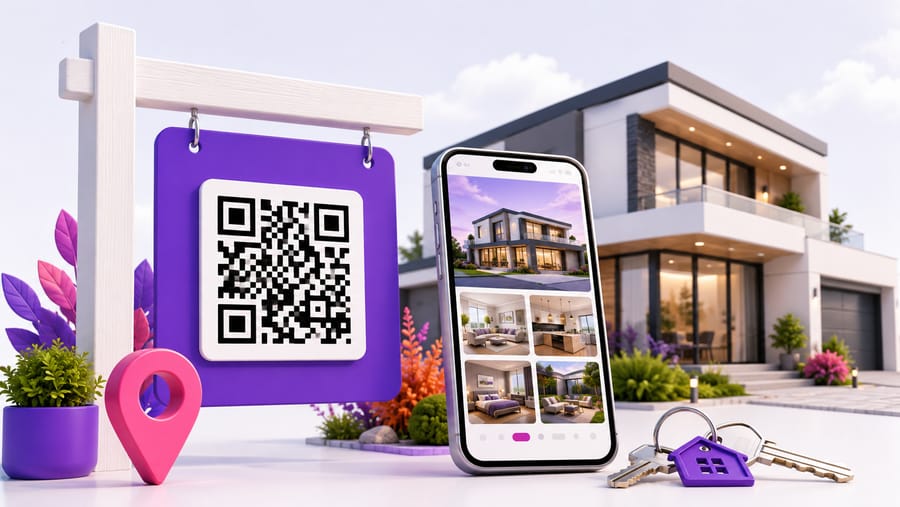
The single best argument for QR codes in property has nothing to do with technology. It is that people walk past houses in the evening.
Someone likes the look of a place at nine at night. The office is shut, the board has a phone number they will not ring, and by morning they have forgotten the street. A code on that board answers the three questions they actually have — price, floor plan, photos — while they are standing in front of the property and interested.
Where a code earns its place
- The For Sale or To Let board. The one that matters. Everything below is secondary.
- The window card. Out-of-hours browsing at the office window is the same behaviour indoors.
- Printed particulars. A code beats a URL nobody types, and it lets you update the brochure's content after printing.
- Open-house material. A code to the floor plan and the full photo set, so visitors are not thumbing through paper.
- The agent's card. A contact card code saves name, phone and email in one tap — useful precisely because a viewing ends with "send me the details".
Board codes have to be big, and most are not
The working rule is about a tenth of the reading distance. A board read from the pavement three metres away wants a code around 30 cm across. If people scan from a slowing car, more.
This is where most agency boards fail: a 5 cm code in the corner of a large board looks proportionate in the artwork and is unreadable from where anyone stands. Print one board, stand where a passer-by stands, and scan it before ordering fifty.
Outdoors also means weather. Laminate or UV-stable ink, and expect to replace board faces that have been in sun and rain for a couple of years.
One code per property — this is the part that pays
The temptation is one code for the agency, pointing at the website. It is easier to manage and it tells you nothing.
Give each listing its own code and the scan count becomes a real number: which property draws attention, which board placement works, whether the new photos changed anything. That is a line you can put in a weekly vendor update — "the board was scanned 34 times this week" is concrete in a way "we have had some interest" is not.
With bulk generation you create a batch from a spreadsheet in one go rather than making them one at a time, which matters once you are running thirty listings.
Why the code should be dynamic
Property listings have a short life and boards do not come down promptly:
- Under offer. Repoint the code to a page that says so and lists similar properties, instead of a listing that no longer reflects reality.
- Sold or let. The board may stay up for weeks as advertising. Point the code at a valuation enquiry — the people scanning a sold sign are often the neighbours, which is exactly who you want.
- Portal changes. When a listing URL changes, or you move portals, the printed boards keep working.
A static code pointing at a listing URL becomes a dead link the day that listing is archived, on every board and brochure you printed.
What to point it at
The listing. Not the homepage, not a search results page, and not a lead-capture form before the content. Someone standing in the street who is asked for an email address before they can see the price simply leaves.
Two things to check on the destination: that it opens fast on mobile data, and that the price and floor plan are visible without scrolling past a gallery. If your portal listing does that better than your own site, point at the portal.
For enquiries specifically, a WhatsApp code with the address already in the first message removes the awkward opening. "Hi, I'm asking about 14 Green Lane" arrives with the context you need.
What the numbers will and will not tell you
You get scans over time, device, operating system, browser and referrer, plus unique visitors from a hashed IP. That answers which listing and which placement.
You do not get location. There is no geolocation in the analytics at all, so you cannot report where a scan happened. If you want to compare the board outside the property with the card in the office window, give each its own code — which is also more reliable than location data would be.
Two things to get right before printing
- Permission. A board goes on someone else's property. Codes on a vendor's gate, a block's communal fence or a shop front need the owner's agreement like any other signage.
- Tamper checks. A sticker over your code sends your enquiries somewhere else, and boards stand unattended for weeks. If the short link runs on your own domain, a fake becomes obvious to anyone who reads it — and worth a glance whenever someone visits the property.
Quick answers
- How big should a code on a For Sale board be? Roughly a tenth of the distance people stand at — about 30 cm for a board read from three metres.
- One code for the agency or one per property? One per property. That is what makes the scan counts mean anything.
- What should it point at? The listing itself, mobile-first, with no form in front of the content.
- What happens when the property sells? With a dynamic code, repoint it — a valuation enquiry works well, since scanners of a sold board are often neighbours.
- Can I see where people scanned from? No. There is no location data. Use a separate code per placement instead.
- Do codes survive outdoors? With lamination or UV-stable ink, yes, for a couple of years. Replace faded board faces.