Published on 7/30/2026
QR Codes for Weddings: One Code, Printed Once, Useful for a Year
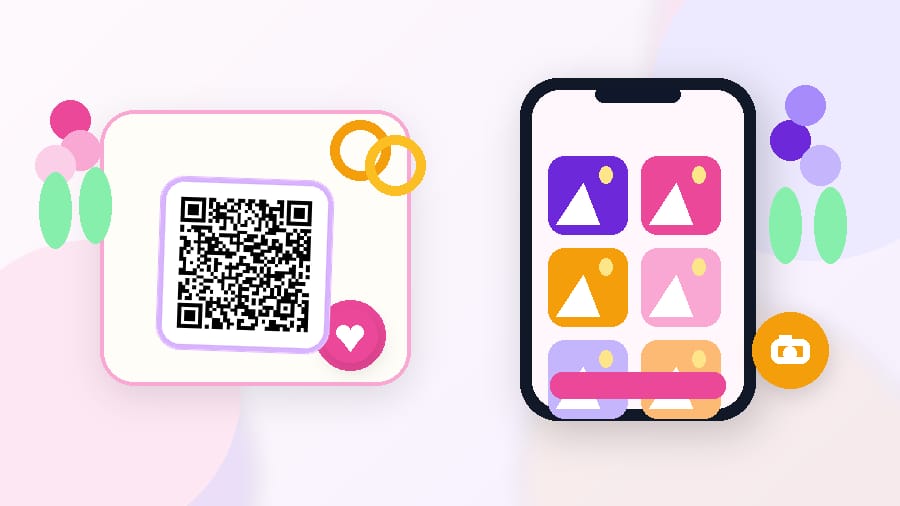
Nobody types a wedding website address off a card. They mean to, they put the invitation on the fridge, and three weeks later they ask you the venue postcode by text.
A code on the invitation fixes that, but it is not the interesting part. The interesting part is that an invitation printed in February is still in someone's kitchen drawer in September — and with a dynamic code you can decide, months later, where it leads.
The one code that does the whole year
This is the pattern worth copying. Make one code, print it on everything, and change its destination as the year moves:
- Save-the-date, six months out. Points at a page with the date and the city. Nothing else exists yet, and that is fine.
- Invitation, two months out. Same code, now the RSVP form, the timings, the dress code, the hotel list.
- The week before. Same code, now the practical page — parking, taxi numbers, when the last bus leaves.
- On the day. Same code on the order of service and the table cards, now the photo upload album.
- Afterwards. Same code, now the finished gallery and the thank-you note. The card in the drawer becomes the way guests find the photos.
A static code cannot do this — it carries the destination inside the pattern, so changing it means reprinting. This is the one case where "dynamic" is not a feature to justify but the entire reason to bother.
It fits in the free plan
Worth saying plainly, because wedding suppliers charge for this. The free plan gives five dynamic codes and 1,000 scans a month, and codes on the free plan do not expire. A hundred-guest wedding uses one code and a few hundred scans. You do not need a subscription for this, and if you only ever make one wedding code you will never hit a limit.
Where to put it, and where not to
Good places: the save-the-date, the invitation's detail card, the order of service, the table numbers, the photo booth sign, the back of the menu, the thank-you card.
Two places to think twice about. The main invitation card — if the design is formal and the code spoils it, put the code on the separate details insert, which is where the practical information belongs anyway. And anything foiled or embossed: see below.
Print details that actually break codes
Wedding stationery is exactly the kind of printing that defeats scanners, because it is designed to be beautiful rather than legible.
- Size. Read at 25–30 cm, so 2.5 cm across is comfortable and 2 cm is the floor. On a table number read from a seat, go bigger — 4 cm.
- Contrast. Blush pink on ivory looks lovely and does not scan. The code needs to be clearly darker than its background; if you are unsure, our editor's scannability check will tell you before you send the file to the printer.
- Quiet zone. Leave clear space around the code — roughly the width of four modules. A decorative border or a laurel wreath drawn tight around it is a common and avoidable failure.
- Foil and letterpress. Gold foil is reflective; under a phone's flash it can blow out and read as blank. Deep letterpress impressions can distort the modules. If you want foil, foil the border and print the code in ink.
- Inverted codes. Light code on a dark navy card looks striking, and some older scanners will not read it. If you go that way, test with more than one phone.
- Monograms in the middle. A logo in the centre is fine — the default error correction level is the highest one, so a modest monogram is recoverable. Keep it under about a fifth of the width.
And the rule that overrides all of the above: scan the printed proof, not the screen. Ask the printer for one card before the run of 120. Screens are backlit and forgiving; a matte card under a candle is not.
Print the essentials anyway
The code is a convenience, not the invitation. Date, time and venue name still belong in ink on the card — for the guests who will not scan, for the ones whose phone is flat, and for the framed keepsake copy. Treat the code as the route to everything you could not fit.
One more: put the plain web address in small type underneath. It costs a line and covers every failure mode at once.
The photo album code
The best use of a wedding code on the day is a table card that says "add your photos here" pointing at a shared album. You get the pictures your photographer was not standing next to, and you get them within the week rather than never.
Two things to keep in mind. A shared album link is effectively public to anyone holding it, so do not post the code publicly on social media if the album is meant for guests only. And check the album accepts uploads from people without an account — several services quietly require one, which is where this idea usually dies.
What you can see afterwards
You get scans over time, device, operating system, browser, referrer, and unique visitors from a hashed IP. In practice the useful bit is the timeline: a spike the week you post the invitations tells you they arrived, and a flat line tells you the code is too small or the post is late.
You do not get location — there is no geolocation in the analytics at all — and you cannot see who scanned. It is a counter, not a guest list. RSVPs come from your form.
Quick answers
- Do I need to pay for a wedding QR code? No. The free plan covers it, and free codes do not expire.
- Can I change where it points after printing? Yes, with a dynamic code — that is the point of using one. Static codes cannot be changed.
- How big on an invitation? About 2.5 cm, and not below 2 cm. Table numbers want 4 cm.
- Can I make it match my colours? Yes, as long as the code stays clearly darker than the background. Check it before printing.
- Will gold foil work? Often not — it reflects. Foil the border, print the code in ink.
- Can I put our initials in the middle? Yes, up to about a fifth of the width. The default error correction handles it.
- Can I see who scanned? No. You see counts, devices and times — no identities and no location.