What Is a Dynamic QR Code? A Complete Guide
A dynamic QR code is a code that spells out somebody's short link instead of your destination. Everything it can do — being edited, being counted, being pointed at different people differently — comes from that one substitution, and so does everything it cannot do.
What happens between the scan and the page
A static code hands the phone your URL and the phone opens it. That is one step.
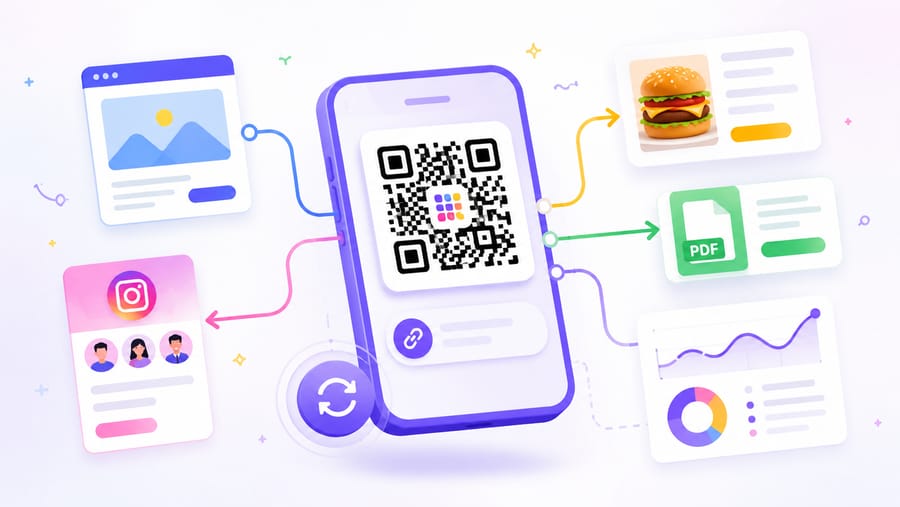
A dynamic code hands the phone something like enqre.com/r/ab12cd. The phone requests that address, a server looks up what it currently points at, notes that the scan happened, and answers with a redirect. The phone then requests the real destination. That is three steps, and the whole architecture of dynamic codes lives in the middle one.
It costs a round trip — a DNS lookup, a TLS handshake and a small response, typically well under a fifth of a second on a decent connection. Nobody notices it. What they would notice is that server being unreachable, which is the trade you are making.
The redirect has to be temporary, and this matters
Here is a detail almost nobody writes down. A redirect can be permanent (HTTP 301) or temporary (302). Browsers cache permanent redirects aggressively — that is the point of them.
If a provider serves your dynamic code as a 301, then a phone that scanned it in March has memorised the old destination. You change the target in April, and that phone keeps going to the old page, possibly for months, without asking the server again. The code appears to have stopped updating for exactly the people who engaged with it first.
A dynamic code must therefore redirect temporarily, every time. If you are evaluating a provider and feeling technical, scan one of their codes with the network tab open and look at the status code.
What the middle step records
Because every scan passes through a server, that server sees what any web request reveals: the time, the user agent string the phone sends — which yields device, operating system and browser — and the IP address, which gives a coarse location, typically no better than a city.
It does not see who the person is, and it cannot read the phone's GPS. A QR code has no way to ask for that, and nothing in the scan grants it. The practical privacy question is what your provider stores, for how long, and what you have to say about it, which is covered in QR codes and GDPR. What you actually get back is in how to track QR code scans.
Because it is a URL, it is always online
This is the limit people meet unexpectedly. A dynamic code is a web address, and a web address needs a connection. There is no dynamic Wi-Fi code, no dynamic contact card that works on a plane, no dynamic anything in a basement with no signal.
Static codes can carry the data itself — Wi-Fi credentials, a vCard, plain text — and those work with the internet switched off entirely, because nothing has to be fetched. If offline operation matters, the choice has been made for you.
The short domain is the real asset
Every dynamic code you print is a permanent bet on one domain name continuing to resolve and continuing to belong to somebody who will honour your redirects. That is not a small thing to hand over on fifty thousand cartons.
It is the argument for putting the redirect on a domain you own — the printed codes then survive a change of provider, because the address in the ink is yours. A custom domain for your QR codes goes through how that works and the one part of it you cannot undo.
What it is for
The mechanism explains the use cases rather than the other way round. Anything printed far in advance of the thing it advertises — packaging, signage, menus, badges. Anything you need to measure, because a static code leaves no trace. Anything that should behave differently for different scanners, since the server can branch on device or language before it answers.
And anything printed at a scale where being wrong is expensive. Which one to use in a given case is the subject of dynamic vs static QR codes; this page is about how the dynamic one works.
Frequently asked questions
Is a dynamic QR code slower to scan?
The decode is identical — and usually faster, because a short redirect link means fewer modules than a long URL. What is added is one network hop before the destination loads, normally under a fifth of a second and not perceptible.
Can a dynamic QR code work without an internet connection?
No. It encodes a web address that has to be fetched, so an offline phone gets nothing. Only a static code can carry its payload directly — Wi-Fi credentials, a contact card or plain text all work with no connection at all.
Why does my dynamic code still open the old destination?
Usually a caching problem: if the redirect was served as a permanent one, the phone remembers it and stops asking the server. A correctly implemented dynamic code issues a temporary redirect on every scan so a changed destination takes effect immediately.
What can the provider see when someone scans?
The time, the device and browser reported by the user agent, and an approximate location derived from the IP address — city level at best. Not identity, and not GPS; the scan gives no access to either.
What happens to my printed codes if I leave the provider?
If the codes carry the provider's domain, they stop resolving and the print is dead. If they carry a domain you own, you can repoint it and the printed codes keep working — which is why the domain question belongs before the print run, not after. Create one free to see how it behaves, or compare the plans.
The Enqre Team·Published on 6/21/2026·Updated 9/17/2026