Published on 8/6/2026
QR Code Marketing: Ideas That Work, Judged by Whether Anyone Scans
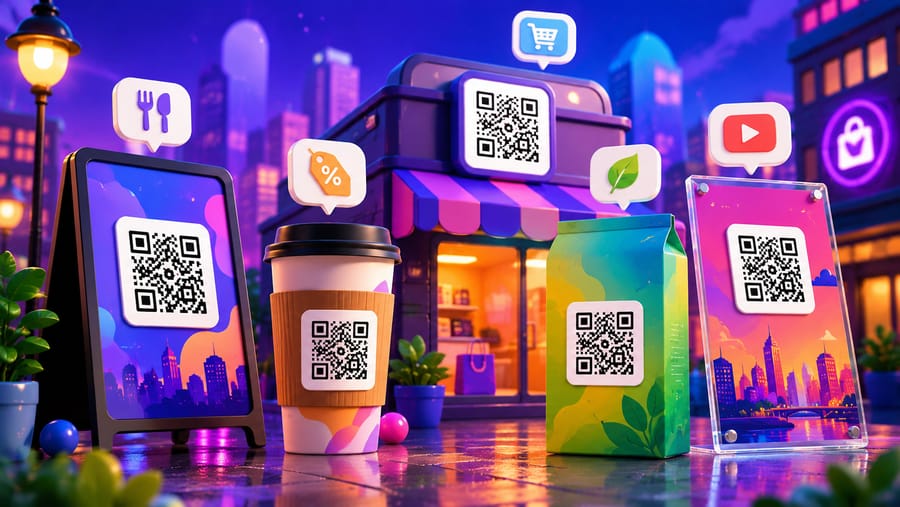
Most QR campaigns fail the same way, and it is not the code's fault. The code is readable, the page loads, and nobody scans — because nothing next to it answered the only question the passer-by has: what do I get?
So this is not a list of ten ideas. It is one test applied to the usual placements: is there a reason, and is it printed where the code is?
The test
Cover the code with your thumb and read what is left. If the remaining words tell someone what they get, the code will be scanned. If they say "scan me", "follow us" or nothing at all, it will not.
Compare: "Scan for the wine list", "Scan to see this flat's floor plan", "Scan for 10% off today" — versus a bare code in the corner of a poster. The first three name a thing the reader wanted anyway. The fourth asks for a favour.
Placements where the reason already exists
These work with almost no persuasion, because the person is already mid-question:
- The restaurant table. They are seated and want the menu. The reason is the situation itself.
- The estate agent's board. Someone is standing in front of a house at nine at night wondering about the price.
- Product packaging in the hand. Ingredients, instructions, spare parts, warranty — questions the packaging cannot fit.
- The hotel room card. Breakfast times and the Wi-Fi password are the two most-asked questions in the building.
- The event ticket or badge. Schedule, room changes, the slides afterwards.
- Anything with a queue. A waiting line is dead time and a phone is already out.
For these the work is not persuasion, it is the destination: a page that opens fast on mobile data and answers the question above the fold, with no form in front of the content.
Placements where the reason must be invented — and often is not
- Business cards. Works for saving contact details in one tap; does not work as "see our website".
- Billboards and vehicle livery. People in cars cannot scan, and the ones who can are moving. Size for the distance or skip it.
- Shop windows. Excellent out of hours, weak during opening hours when the door is right there.
- Receipts. The reason has to be immediate — a review link, a return form — because the receipt is in the bin within the hour.
- Email and social posts. The reader is already on the device that would scan. Give them a link.
Five ideas that pay their way
- One code per placement, same destination. Not an idea about content but about measurement: it turns "the campaign got 800 scans" into "the window got 600 and the flyer got 12", and the second sentence changes what you print next.
- The code that changes after the campaign. A dynamic code on a seasonal poster does not become litter in March — repoint it at the next thing. The poster keeps working after the offer ends.
- Route by language. One printed card, guests in six languages, no flag menu. This is the single most under-used feature in hospitality.
- Split test the destination, not the code. Send half the scans to one landing page and half to another, from the same printed code, and let the numbers decide.
- The review ask at the right moment. On the folder with the bill, given to everyone — not selectively to people who look happy, which breaches Google's and TripAdvisor's guidelines.
What to measure, and what not to promise yourself
Scans are an intention, not an outcome. A code with ten thousand scans and no sales did its job; the page did not. Judge the code by scans and the campaign by what happened after the arrival, which means UTM parameters on the destination and your own web analytics.
One limit to plan around: there is no location data in the analytics at all. If you want to know whether the station poster beat the one in the office, give each its own code — which is more reliable than an IP guess anyway, because it tells you about the placement rather than the phone's network.
The five-minute pre-flight
- Cover the code with your thumb. Is there still a reason to scan?
- Open the destination on a phone with Wi-Fi off. Does it answer in one screen?
- Is the code big enough for the distance — roughly a tenth of it?
- Does each placement have its own code?
- Have you scanned a printed proof, not the screen?
Quick answers
- Why does nobody scan my code? Usually because nothing beside it says what they get. Cover the code and read what remains.
- Where do QR codes work best? Where the person already has the question: the table, the board, the packaging, the queue.
- Should I put one in an email? No — the reader is holding the scanner. Link instead.
- How do I know which placement worked? A separate code for each. There is no location data to tell you otherwise.
- Is a scan a conversion? No. It is an intention. Measure what happens after with UTM parameters.
- What do I do with the poster when the offer ends? Repoint the code. That is what dynamic is for.