
Published on 8/12/2026
QR Codes for Asset and Equipment Tracking (The Sticker That Becomes a Record)
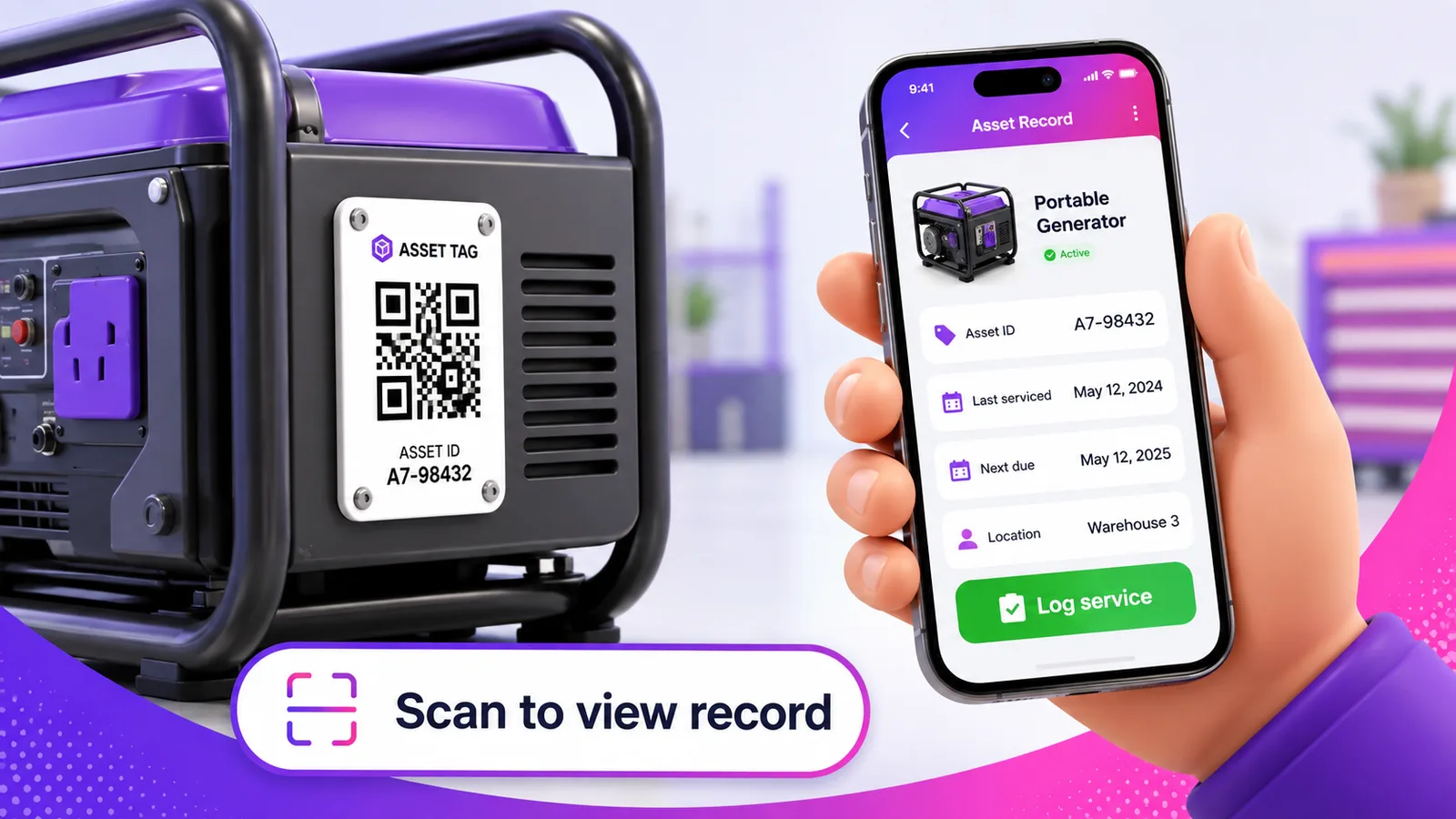
Most asset tracking dies the same way: a spreadsheet of tag numbers that nobody updates, tied to little metal plates nobody can decode when they are standing at the machine with a problem. A QR code flips the whole thing around. Instead of looking up the asset, you scan the asset — and its full record opens on your phone: where it lives, who owns it, when it was last serviced, the manual, and a button to log what you just did. The label stops being a dead number and becomes a live doorway into the record.
The core idea: the code links the thing to its record
Every physical asset has a digital shadow somewhere — a row in a system, a maintenance history, a warranty, a manual. The problem has always been the gap between the two: you are at the boiler, the record is in a database you cannot name, let alone open. A QR sticker closes that gap. Scan it and you land straight on that asset's page, no searching, no "which unit is this again?" It is the shortest path from a thing in front of you to everything known about it.
Because it is one scan to the right record, the codes are worth generating in bulk and applying once. For a fleet of laptops, tools, extinguishers or machines, our bulk generator makes a batch in one go, and if you run your own asset system, the API can mint and assign them programmatically.
Maintenance logs that actually get kept
The single biggest win is service history. A technician walks up to a machine, scans the code, and sees the last service, the next one due, and the parts fitted — then logs today's work on the spot, from the same phone. No paper form to lose, no "I'll update the sheet when I'm back at my desk" that never happens. The record stays current because updating it is easier than not updating it, which is the only way a log survives contact with a busy week.
Fault reporting without the guessing game
Put a code on anything that breaks and gets reported — a printer, a lift, an AC unit, a playground swing, a hospital bed — pointing at a "report a problem" form. The magic is that the form already knows which asset it is: no "the printer near the kitchen, the second one, not the broken one" confusion. The fault lands tagged to the exact unit, with its location and history attached. Route those reports like any other form submission and the person who fixes it starts with the full picture instead of a riddle.
Audits and inventory at walking speed
The annual inventory is usually a clipboard, a squint at faded labels, and a lot of hope. With codes, an audit becomes a walk: scan each asset to confirm it exists and is where it should be, and the count updates as you go. The same check-in / check-out mechanic handles shared kit — AV equipment, library gear, tools, hire stock — scan to borrow, scan to return, so the system always knows who has what.
Compliance you can prove
Fire extinguishers, ladders, PAT-tested electricals, lifting gear — anything with an inspection cycle — carries a code that opens its inspection record and next-due date. The inspector scans, checks, and logs on the spot, building a timestamped trail you can show an auditor. When someone asks "when was this last checked?", the answer is a scan away rather than a filing-cabinet expedition. For manuals and safety sheets, point a code straight at the PDF so the document is with the equipment, not in an office drawer.
Why asset codes should be dynamic
Here is the subtle part. The asset never changes, but where its record lives absolutely can — you switch maintenance systems, migrate to a new platform, reorganise how records are stored. With dynamic codes, you repoint every label to the new destination in one move, without peeling and re-applying thousands of stickers across a site. You also get a scan history per asset — which machines get looked up most (often your maintenance-heavy problem children), and a record of who checked what, when. Read it in your scan analytics. A static code hard-codes one URL and takes a re-labelling project to change.
Make it survive the real world
An asset label lives a harder life than a poster. Get three things right and it lasts:
- The right material. Outdoors, on machinery, in a workshop or a freezer, a paper sticker will not last. Use durable labels suited to the surface — our guide to codes on metal, wood and fabric covers the trade-offs.
- Higher error correction. In dirty, greasy or scuffed environments, a code that can still read when partly damaged is worth the density. See error correction levels.
- Enough size and contrast. A code scanned at arm's length in bad light needs room — see print size, and if one gives trouble, why codes won't scan.
The questions worth settling first
Does each asset need its own code?
Yes — one code per asset, each pointing at that asset's own record. That one-to-one link is the entire value; a shared code that opens a generic page tells you nothing about the specific unit.
Do staff need an app to scan?
No. Any modern phone reads the code from its camera and opens a web page. Keeping it app-free is what makes a passer-by, a contractor or a new hire able to use it on day one.
What about private records — should anyone be able to scan?
The code just carries a link; what sits behind it is your choice. Point sensitive records at a page that requires a login, and keep public-safe info (a manual, a fault form) open. Mind personal data in any scan logs — our note on QR codes and privacy covers it.
Can I change where a label points after it's stuck on?
Only with a dynamic code. That is exactly why they suit asset tracking: the sticker stays on the machine for years while the system behind it can change as often as it needs to.
How do I label hundreds of assets at once?
Generate the batch with a bulk generator, or mint them from the API if you are wiring this into an existing asset database.
Build an asset system where the sticker never changes but the record behind it always can — create a dynamic QR code free, no card needed.