Published on 8/12/2026
QR Codes for Gyms and Fitness Studios (That Cut Churn and Fill Classes)
A gym lives and dies on two numbers: how many people walk in for a trial, and how many are still swiping their card six months later. Both are won or lost on the floor — at the machine a beginner is too shy to ask about, at the studio door where a class is running half-empty, at the window a passer-by glances at on the walk home. A QR code puts something useful at each of those moments: a form demo, a booking screen, a sign-up. Done right, it also quietly tells you which machine confuses people and which window sells memberships.
The one that pays for itself: equipment demo videos
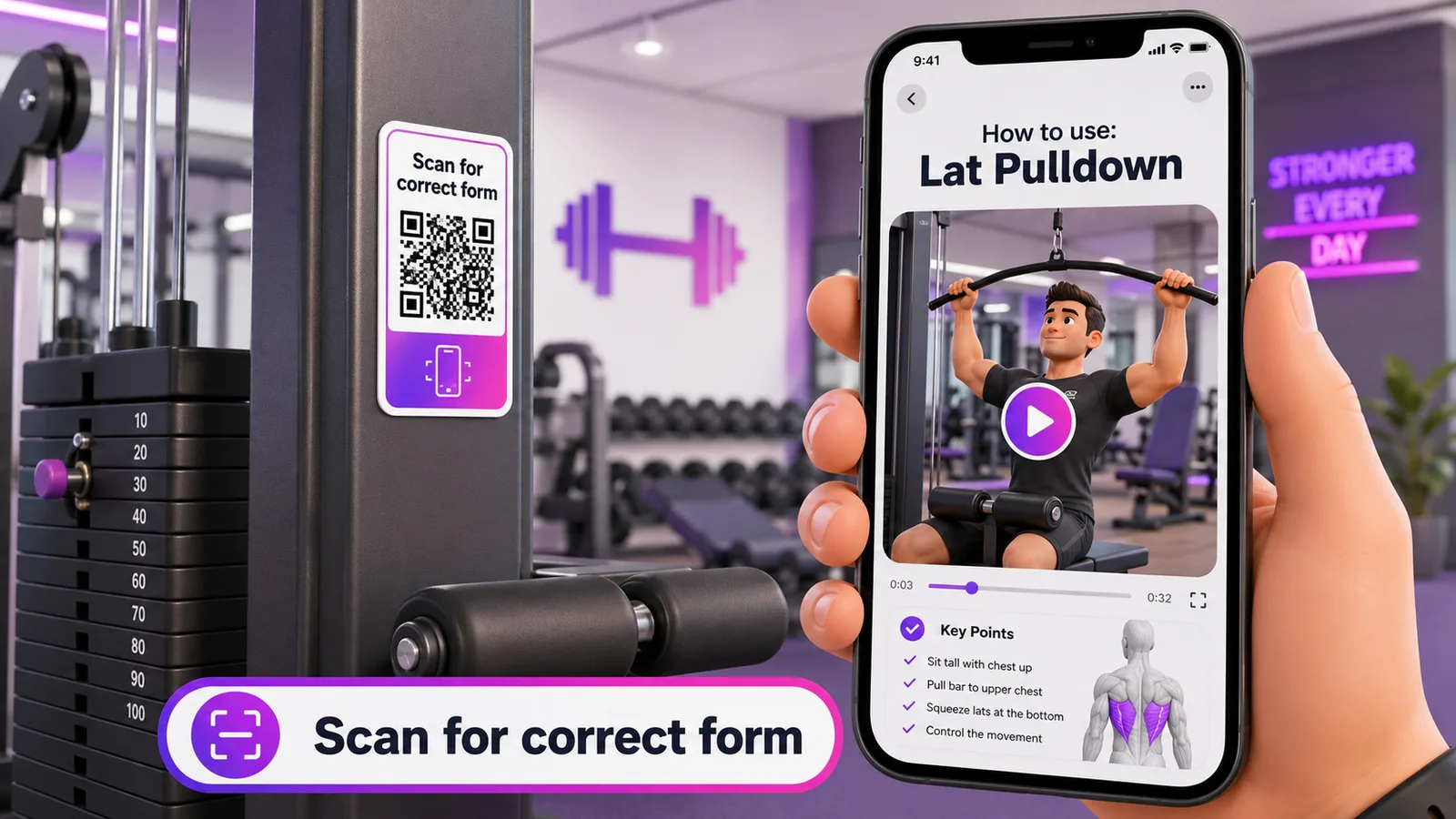
Beginners are the members most likely to quit. They feel lost, they are quietly embarrassed to ask, and one bad experience on a machine they set up wrong is often the last time they touch it. Put a small QR sticker on each piece of equipment that opens a 20-second video of the correct setup and form, and you remove that friction at the exact moment it bites.
Two reasons this is the highest-value code in the building. First, it directly protects retention — a confident beginner comes back. Second, the scans hand you a heat map of confusion: the machines that get scanned most are precisely where members feel lost, so that is where you station a trainer, add a clearer label, or run a "how to use the rig" session. Because the code is dynamic, when you re-shoot the video or replace the machine, you repoint the same sticker instead of peeling and reprinting.
Fill classes without staffing the front desk
A half-empty 6am class is revenue that evaporates the moment the hour passes — you cannot sell that seat later. A QR on the studio door and the schedule board that opens the live timetable and books a spot in three taps recovers some of it, and it works when the desk is unstaffed. Keep the code dynamic so the link stays right when the timetable shifts with the seasons — you change the destination, not the decal on the glass.
Your front window is a 24/7 salesperson
This is the growth trick most gyms miss. The gym is closed at 10pm, but people still walk past — after a late shift, on the way back from dinner, exactly when they are thinking "I should get back in shape." A QR on the window that opens a free-trial or day-pass sign-up captures that impulse while the desk is dark. Track the scans by hour and you will almost certainly find a spike after closing that you never knew existed — a whole audience the staffed hours never reach.
Extend the same idea beyond your own wall. Drop flyers where your future members already are — cafés, physio clinics, offices, student halls — and give each location its own dynamic code, all pointing at the same trial offer. Now you can see which neighbourhood drop actually pulls sign-ups instead of guessing, and reprint only the ones that work. Pair it with redirect rules to A/B two offers, and read the results in your scan analytics. There are more placement ideas in our QR marketing playbook.
The relationship layer: trainers, referrals and reviews
Retention is a relationship, and a few small codes strengthen it:
- Personal trainers. A QR on each trainer's board photo opening their bio, specialties and booking link. Give every trainer a separate code and you can see who is in demand — useful for scheduling and for the trainers themselves.
- Referrals. A "bring a friend" code on the member welcome card or the locker mirror. Members recruit better than any ad, and a code makes the ask effortless.
- Reviews. A code at the exit — or on the receipt — that opens a Google review. Ask when the endorphins are high, right after a session, and far more people say yes. Feedback you would rather keep private can route to a short survey instead.
Static or dynamic? For a gym, almost always dynamic
Equipment stickers, door decals and window clings are a hassle to reprint, yet the things they point to — schedules, promos, videos, even which trainers you employ — change constantly. That combination is exactly what a dynamic code is for: the printed square stays put, and you repoint it whenever the destination changes. You also get per-placement scan counts, which is what turns "we put up some codes" into "the window code brings twice the trials of the front-desk one." A static code bakes the link in and tells you nothing.
A quick floor plan
- Equipment: form and setup videos, one machine per code.
- Studio doors: live class schedule and booking.
- Front window: free-trial / day-pass sign-up — your after-hours capture.
- Locker rooms and mirrors: gym app download or a workout-program PDF.
- Water station and rest benches: a calm moment — good for a review or your community channel on Instagram, WhatsApp or Telegram.
- Front desk: membership plans and day passes.
- On the street: a how-to-find-us code on the A-board, and joining offers on local flyers.
The bits worth getting right
Do members need an app to scan?
No. Every modern phone reads a QR straight from the camera app — no download, no friction. That is the whole point of using one on the floor.
What should an equipment code link to?
One short form-and-setup video per machine — muted, gets to the point in a few seconds, and reachable without a login. One machine, one code; do not send every sticker to the same generic playlist.
How do I know which placement is working?
Give each spot its own dynamic code and compare scan counts. The window versus the front desk, this trainer versus that one, the café flyer versus the office one — the numbers end the argument.
Can I change the class-schedule link after printing?
Only with a dynamic code. A static one freezes the link; a dynamic one keeps the same decal on the door and lets you repoint it every time the timetable changes.
Won't stickers everywhere look messy?
Use one branded style and keep each code small but scannable — roughly 2–3 cm minimum, high contrast, with quiet space around it. A tasteful code reads fine at arm's length; if one gives trouble, our note on codes that won't scan covers the usual fixes.
Make a gym code you can repoint and measure any time — create a dynamic QR code free, no card needed.