How to Make a QR Code for Your LinkedIn Profile
LinkedIn has a perfectly good QR code built into the app, and for meeting someone in person it is the right tool. The question worth more thought is whether LinkedIn is the right destination at all for a code you are about to print on five hundred business cards.
The built-in code, and what it is actually for
Open the LinkedIn app, tap the search bar, tap the QR icon at its right edge. Your code is under "My code"; the "Scan" tab reads someone else's.
It is an ordinary QR code — any phone camera will read it and open your profile, not just the LinkedIn app. This is worth saying because it is often described as app-only, and it is not. What it genuinely cannot do is carry your branding, report how many people scanned it, or point anywhere other than your profile.
For its actual purpose — two people standing in front of each other, one holding up a phone — none of that matters. Use it.
Fix your profile URL before printing anything
LinkedIn gives everyone a default address with a random suffix, something like linkedin.com/in/jane-smith-a1b2c3d4. You can change it under Edit public profile & URL to the clean linkedin.com/in/janesmith.
Do that before you generate a code for print. It removes eight or nine characters of noise, which is a meaningful fraction of a short URL and shows up directly as a less dense pattern. It also means the address is speakable, which matters more than people expect — half the value of a printed link is that someone can read it out.
On a badge or a card, a vCard usually beats a profile link
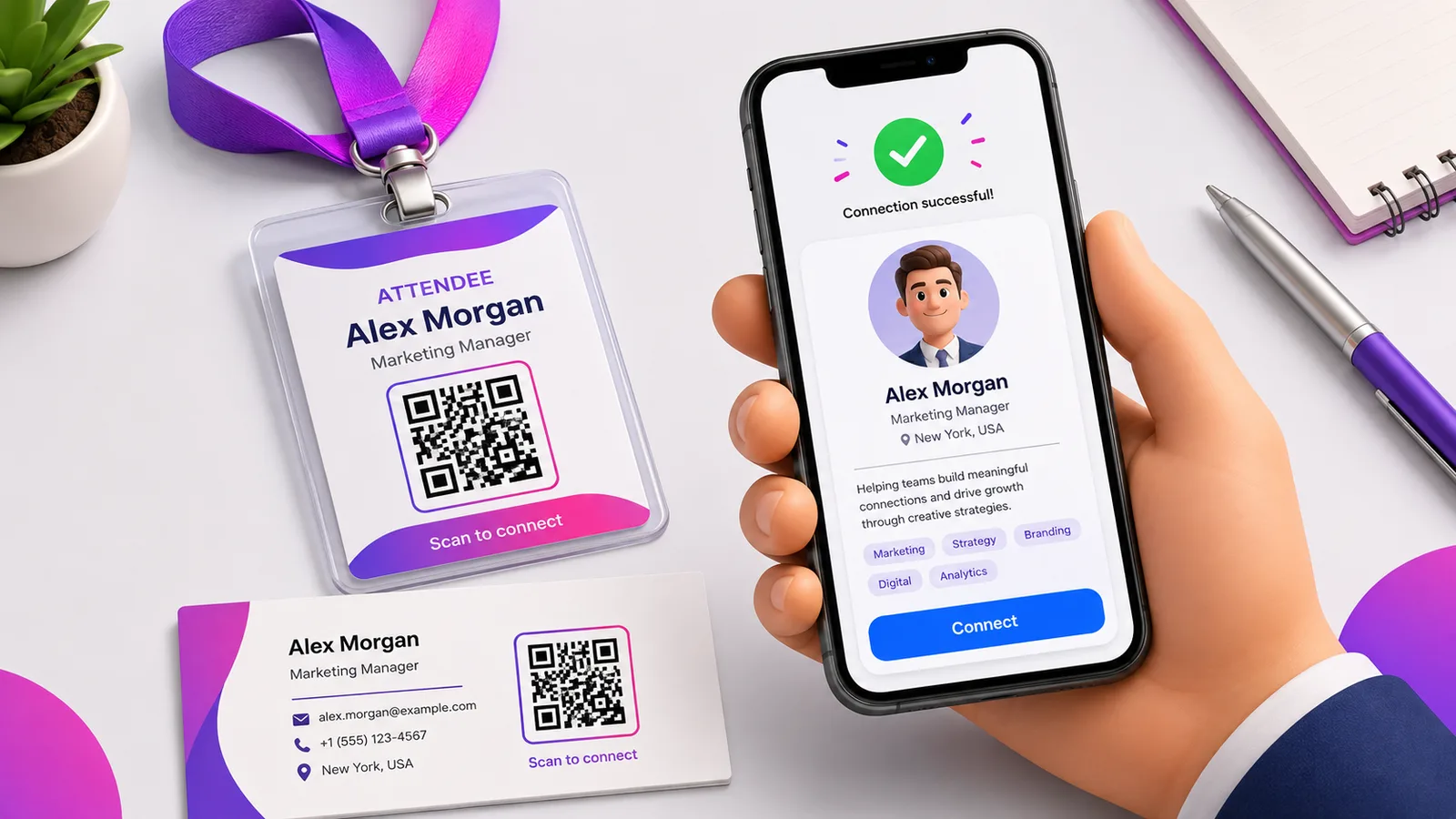
This is the part most guides skip. A LinkedIn code sends someone to a profile, where connecting requires them to be logged in and to remember to act. At a conference, that intention survives about as long as the walk back to the seat.
A vCard code behaves differently: the scan produces a contact card their phone offers to save immediately — name, number, email and your LinkedIn URL inside it. Nothing depends on a session, an app, or on them coming back to it later. If you are printing one code on a business card, that is usually the one to print.
The exception is when being found on LinkedIn is the point — a speaker slide, a recruiter-facing booth, a talk where you want followers rather than contacts. Then the profile link is correct.
This is one of the few cases where static is fine
Most advice pushes dynamic codes at everything. A LinkedIn profile URL is a genuine exception: it belongs to you, it survives changing jobs, and it does not expire when a campaign does. A static code pointing at it will still work in ten years with nobody paying anything.
Prefer a dynamic code when you want the numbers — how many people at which of four events actually scanned — or when you might re-point the card at a portfolio or a booking link later. Both are reasonable here. What is not reasonable is a dynamic code on a card you will carry for years with a provider you have not checked the shutdown policy of. A dead code on a business card is worse than no code.
Where it earns its place, and where it does not
It works on a card, a badge, a booth wall and the last slide of a talk — all situations where somebody is looking at a physical thing and holding a phone.
It does not work in an email signature, and this is the most common misuse. The reader is already on a device. Asking them to point a second phone at their own screen to reach a link you could have made tappable is a worse experience in every case. Put the URL in the signature as a link.
Frequently asked questions
Can a normal camera scan LinkedIn's built-in QR code?
Yes. It is a standard QR code encoding a link to your profile, so any phone camera reads it and offers to open the page. The limitation is not scanning — it is that you cannot brand it, measure it or re-point it.
How do I get a clean LinkedIn profile URL?
On your profile, open Edit public profile & URL and set a custom address. The default includes a random alphanumeric suffix; removing it shortens the link, makes the code less dense, and gives you something you can say out loud.
Should my business card link to LinkedIn or to a contact card?
A contact card, in most cases. A vCard saves straight into the recipient's phone with no login and no follow-up step, whereas a LinkedIn scan needs them to be signed in and to actually send the request. Link to LinkedIn when being followed publicly is the goal rather than being contacted.
Should a LinkedIn QR code be static or dynamic?
Static is defensible here, which is unusual. Your profile URL is stable and outlives job changes, so a static code keeps working indefinitely with no dependency on any service. Choose dynamic if you want scan counts, or if you might later re-point the same printed card at a portfolio.
Can I change where it points later?
Only if you made it dynamic. A static code has the address baked into the pattern and the only edit is a reprint. Create one free if you want the option to move the destination without reprinting the cards.
A equipa Enqre·Publicado a 11/08/2026·Atualizado 17/09/2026