How to Add a QR Code to Your Resume (CV)
Almost nobody prints your CV any more. That single fact decides most of what follows, because a QR code on a document being read on a laptop is a code nobody can conveniently scan — and it is the reason a QR on a resume has to be an addition to a normal hyperlink, never a replacement for one.
Who is actually holding the paper
Be honest about the path your CV takes. It is uploaded to a portal, parsed by software, read on a screen, and forwarded as a PDF. The printed copy appears late if at all — in an interview room, on a panel's desk, at a careers fair.
So the code is for that last mile, and only that. Everywhere else it is decorative at best and, if it is the only route to your portfolio, actively harmful: a reader on a laptop cannot scan their own screen without picking up a second device, and they will not.
Which gives the rule the rest of this hangs on. Every destination behind the code must also appear as plain, clickable text somewhere on the page.
The applicant tracking system cannot see it
This is the part that costs people interviews. Screening software extracts text. A QR code is an image, and an image contributes nothing — no URL, no keywords, nothing that can be indexed or matched.
If your portfolio link exists only inside the code, then as far as the first automated pass is concerned it does not exist. Write the URL out. The code is a convenience layered on top of a document that has to survive being read by a machine first.
Pick one destination
One code, one place. A page of competing squares reads as gimmickry, and a link hub asking a recruiter to choose is one decision more than they wanted to make.
The portfolio or personal site is the strongest choice, because it shows work rather than asserting it. LinkedIn is the sensible default for roles where the profile is the portfolio. A vCard — name, phone, email saved in one tap — is the right answer only in person, at a fair or an interview, where the point is to be contacted rather than researched.
Making it survive the print
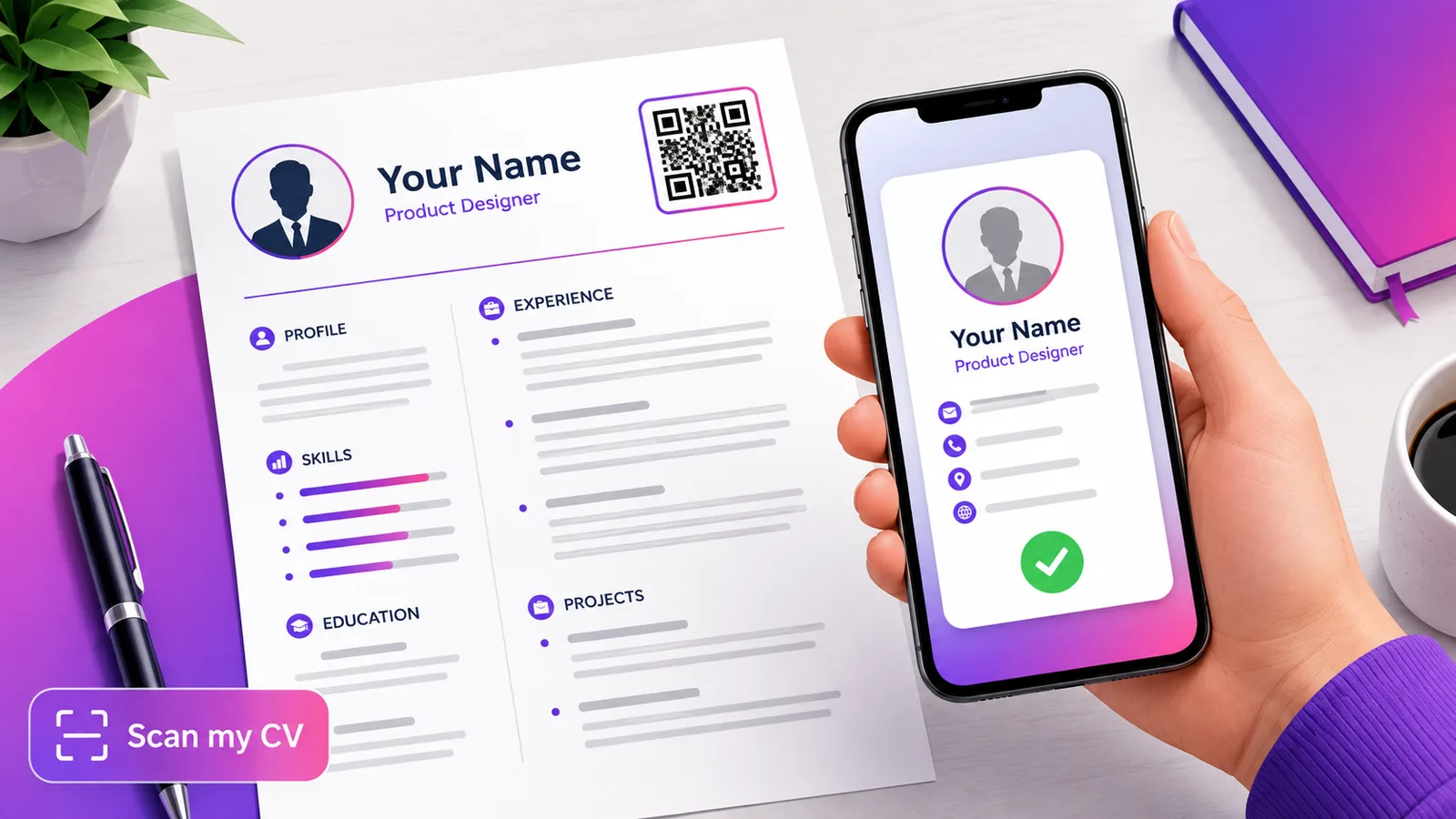
About 2 cm square in the header, beside your contact line, with a short label — "Portfolio" is enough. The label matters: an unexplained square is a small act of mystery on a document that should contain none.
Keep it dark on white, and leave the quiet zone alone. The blank margin around the pattern is part of the code, and a header is exactly where it gets crowded by a name, a rule or a border. Check the design with the contrast checker, then confirm the exported file decodes with the scan checker — and test the actual exported PDF, not the design you were looking at. A code that was fine at 100% can fail once the PDF is flattened and downscaled.
Static, in almost every case
A CV is unusual: once sent, a copy is gone. It sits in inboxes and applicant systems for years, and you cannot recall it.
That argues against a dynamic code, not for one. A dynamic code is a dependency on a service continuing to exist, and the failure mode is a recruiter in eighteen months scanning a dead square — worse than no code at all. Point it at a URL you control and intend to keep, and let it be static.
The case for dynamic is narrow but real: if you are handing out printed copies at events and genuinely want to know whether anyone scans them, or you expect to move your portfolio and want the copies already out there to follow, a dynamic code does that. Just make it a decision rather than a default.
Frequently asked questions
Can an applicant tracking system read a QR code?
No. ATS software parses text, and a QR code is an image containing none. Any link that matters — portfolio, LinkedIn, GitHub — must also be written out as text, or the screening pass will never see it.
Is a QR code on a CV unprofessional?
Not if it is small, labelled and points at something that helps your case. It reads badly when it is large, unexplained, duplicated, or used in place of writing the URL down — all of which suggest the document was designed rather than written.
Where should it go on the page?
The header, next to your name and contact details, around 2 cm square. Give it clear white space on all four sides; that margin is part of the code, and header layouts tend to crowd it with rules and borders.
Should it be static or dynamic?
Static, usually. Copies of your CV stay in inboxes for years and cannot be recalled, so a code that depends on a service staying live is a risk with little upside. Use dynamic only if you want scan counts from printed copies, or expect to move the destination.
What if the recruiter reads it on a screen?
Then the code does nothing for them, which is exactly why the same links have to be present as ordinary clickable text. Treat the QR as a shortcut for the minority holding paper, not as the way your links are delivered.
A equipa Enqre·Publicado a 12/08/2026·Atualizado 17/09/2026